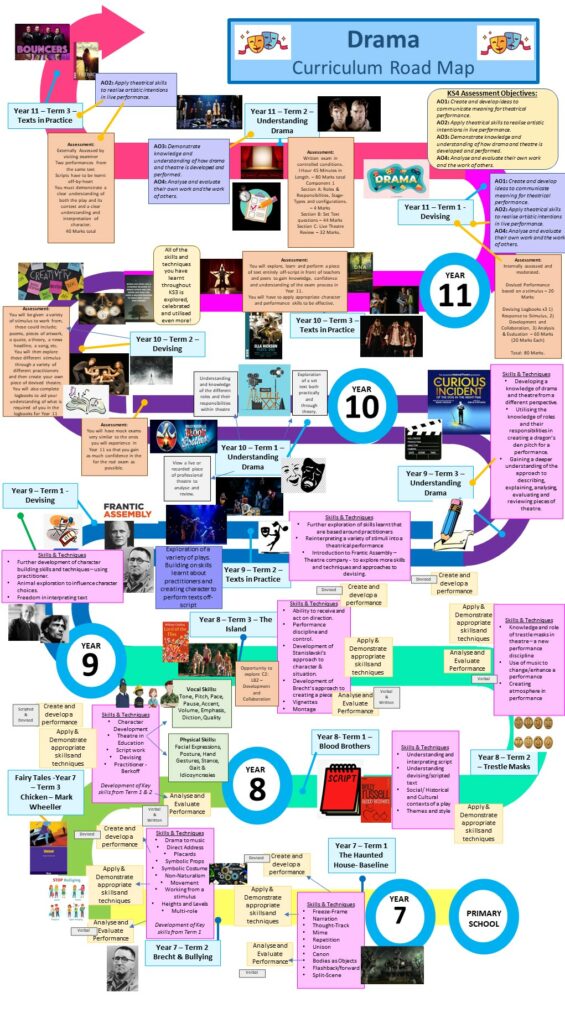
Topics covered in Drama are detailed below
Year 7 – Unit 1 – Foundational Skills:
This unit takes place over the course of the first full term and is designed to introduce Drama as a subject and to build the initial practical drama skills required to access all future learning.
During this unit, students are introduced to a range of scene building techniques, such as Freeze-Frames and Thought-Tracks, developing their Mime skills and world-building through Bodies as Objects.
The unit finishes with students creating their first assessment performance, after which, students will feedback to each others and complete self-evaluations to cement the learning done over the term.
Year 7 – Unit 2 – Brecht and The Titanic
Here students get their first experience of a Drama practitioner, Bertolt Brecht. Over the course of the unit, students will explore the story of what happened to the famous cruise ship and the lives of those on board. Alongside this, students learn about how to perform Drama through the narrative lens of Bertolt Brecht, creating performances which encourage audiences to consider social messages.
Students finish the unit with a final assessed performance and a written self-evaluation.
Year 7 – Unit 3 – ‘Chicken!’ Script
Building on the introduction of intentional messaging in performances, students are introduced to their first script. During each lesson, students develop their understanding of ‘blocking’ a performance and how to reflect and interpret a character from page to stage. The play ‘Chicken!’ offers a chance to learn about Theatre in Education, a form of Brechtian performance based on creating performances with a clear and driven message.
Year 8 – Unit 1 – ‘Let Him Have It’
This unit aims to re-introduce the idea of devising a performance from stimulus. The stimulus for this unit is ‘Let him have it’, the story of Derek Bentley. The 19-year-old executed for being involved in the death of a police officer despite him not actually firing the gun that killed the officer. Students will be introduced to the stimulus, they will further explore the themes using the practitioner Brecht and the style ‘Physical Theatre’ to devise engaging and imaginative retelling of the story of Derek Bentley, and eventually devise unique, original performances based on the themes from the unit as a stimulus.
Year 8 – Unit 2 – Curious Incident
This unit returns to challenging students to understand and interpret a script. This time the script is the contemporary play ‘The Curious Incident of the Dog in the Nighttime’. This unit will explore the themes of the play, namely autism and how autism is affected by the larger world. This play has been chosen in response to the cohort at Roundhill. It is chosen to educate students not only about Drama, but also to raise awareness and understanding around the experience of others within the school community.
As part of this unit, students will learn how to design set and costume around the context of the play. Students will also continue to learn how to devise and create performances based on a set text. Students will also build on their understanding of physical theatre style. All of these new or developed skills translate directly to the OCR exam specification.
Year 8 – Unit 3 – Theatre Styles
This unit is designed for the love of learning, and for the love of the subject. It is designed to be an engaging and fun learning experience across three disciplines which students may decide to use in future devising of original or text-based work. The unit covers three disciplines: Trestle Theatre mask work, Puppetry (Gyre and Gimble), and Stage Combat.
The unit widens the toolkit of students to understand wider Drama skills to further diversify their devising abilities. These skills may be used throughout future units to enhance responses to different stimulus, diversifying performances and allowing students a broad understanding of the performing arts.
Year 9 – Unit 1 – Practitioners
This unit aims to introduce a further three separate practitioners and styles to students:
- Stanislavski and naturalistic acting. Students are introduced to a core idea behind naturalistic acting and methods to become more believable in their choices.
- Berkoff and Total Theatre – Combining and building on the physical skills learned over year 7 and 8 students are introduced to the high intensity storytelling vision of playwright and practitioner Steven Berkoff.
- Artaud and Theatre of Cruelty – Students visit the extremes of the Avant Garde ‘Theatre of Cruelty’. A style of theatre which pushes audience’s senses to the limit.
This unit is designed to instil a love of the wide range of performance styles which are on offer. Students find which style speaks to them the most, and from this, begin develop their own personal style and taste.
Year 9 – Unit 2 – Top Girls
This unit builds on previous scripted SoWs and continues the themes of exploration of topics thrown up by the chosen play. Top Girls is a groundbreaking play by the playwright Carol Churchill. Students start by exploring the characters and understanding the over-arching theme of the unit, followed by a brief understanding of the three waves of Feminism. Students all the while are tasked with learning and presenting an extract as part of the final examined performance, which is completed to a similar expectation as the OCR GCSE framework ie. Completing an artistic intentions form.
Year 9 – Unit 3 – The Wider Theatre
Up until this point, students have focused on Drama purely through the lens of either acting or directing. At this point in year 9, students will have chosen options. This unit aims to introduce technical understanding to the curriculum of lighting, sound, costume and make-up which function typically behind the scenes in theatre. Students will be introduced to different types of theatre light and their uses, as well as exploring decisions around make-up and costume to help the audiences understanding of character. This unit will explore these roles through the play Billy Elliot, and the final assessment will involve all disciplines of stage tech alongside performance elements. This unit both prepares students for GCSE level Drama, and also provides an introduction to wider careers in theatre that isn’t just about the performing.
Year 10 – Monologues Unit
Students jump straight into Drama at GCSE level with a first assessment. Monologues! The foundation to any good actor’s repertoire. Students can be provided with a range of monologues from our range of plays, or students can bring their own. Students spend time revisiting the foundations of naturalistic acting, rehearsing their pieces, until a final assessment in front of their peers! Once this performance is completed students will practice detailed self-evaluations to document their achievements and set targets for future progress.
Year 10 – Brecht
The second unit, students will get the chance to revisit Brecht. This unit focusses on developing learners’ points of view, introducing a stimulus and asking students to create a performance which makes an audience think differently. This unit clearly breaks down the Brechtian techniques to separate the audience from the performance, and to practice making an artistic intention as clear as possible. As with every unit in year 10, students will complete a detailed self-evaluation to document progress and to set targets for improvement.
Year 10 – Physical Theatre
The final ‘practical’ based unit before GCSE assessment units start, students will be introduced to the key concepts of physical theatre, namely the theatre company Frantic Assembly, building on the introduction taught in year 8 and expanding on ‘quality’ of movement (Pace, Emotion, Exaggeration). Students work in groups to create a piece of physical theatre based on a piece of music for stimulus.
Year 10 – AO1/2 – Devised
In the new year, year 10 begins their GCSE assessment in earnest. Students are tasked with creating a performance from a choice of 10 set stimulus. Students at this point draw on all of their acquired knowledge, as well as considerable research, to create their performance. As students create their performance, they will also ‘log’ their progress and choices as part of a ‘portfolio’. Students’ finished portfolios and performances are marked internally before external moderation.
Year 11 – AO3 – Performing Texts
In year 11, students will be given a choice of texts which they will perform to an external examiner. Students will take time to read and research the play in their groups before rehearsing over the course of the academic year. Students will regularly perform to peers, practicing feedback as if they were the examiner, highlighting good reflecting practice and professional development.
Year 11 – AO4 – Performance and Response
This unit is introduced in year 10 in preparation for year 11. Students will learn about the play ‘Blood Brothers’ by Willy Russell. Students will read, watch and practically explore the play at different points to build an understanding of character, plot, themes and context. Students also build on the year 9 ‘Wider Theatre’ unit to further explore and develop knowledge of costume, set, lighting and sound design, before applying this knowledge to the play.
Alongside this, each year students have the wonderful opportunity to watch a live professional theatre performance! This performance is part of the course and students will respond to the performance in a ‘review’ format as part of the final examination paper.