Geography

In Geography, students learn through skills. Throughout year 7, 8 and 9, students will practice map skills; read climate graphs, interpret data and use models to apply and compare their understanding. There are also opportunities to practice fieldwork techniques throughout the course to gain an insight into how a Geographer collects and uses data to conduct research.

An emerging learner will be expected to take prompts from the teacher and use support to access geographical content and skills. They will identify and define key ideas.

A secure learner will be expected to work more independently, confidently describe and start to explain geographical content and skills.

An exceeding learner will use his/her/their initiative to describe and explain. They will also evaluate ideas, link and apply to other content studied. They will also start to compare content at different scales; local, regional and global.
Topic 1- How do I become a Glorious Geographer? This topic looks at all the foundation knowledge and skills that a Geographer needs in the wider world.  Skills taught in this topic will support and become a framework for learning in future topics. It includes map work with grid references, climate graphs, GIS, as well as most importantly, local, national, and global locational Geography. The common theme that threads our Geography curriculum together is sustainability. We explore three types of sustainability and learn how Earth requires a well-managed balance between meeting the needs of people and the environment.
Topic 2- Why is there uneven development?


Through this topic students will look at world development and why some countries are more developed than others. Students will discover the different ways in which development can be measured and the barriers that countries face when trying to become more developed. This topic will then focus on the continent of Africa and look at how one continent can have a wide range of development using the example of Kenya to explore this. Kenya is an example of one country within the African continent that has developed significantly since gaining independence and students will discover how Kenya has been able to achieve this.
Topic 3- Can planet earth survive 9 billion people? This topic investigates where people in the world live, why they live where they do, the rapid growth of world population and the impact the population is having on our planet. Students begin by looking at how population has changed over time and what has caused these changes. They will then go on to find out what impact population is having at a local scale by study Leicester and then study the impact of population on a global scale by investigating population in the Philippines.
Topic 4- Is weather hazardous? This topic encourages students to learn about different weathers, weather systems, the reasons for changes in weather locally and globally and the impact of more hazardous weather. Students will use maps, GIS and graph skills when analysing climates. Case studies that are examined in closer detail are Cyclone Freddy in southeast Africa and the Australian Big Dry where drought had a massive impact on farming and food prices. Digging even deeper, we compare and analyse the different responses to extreme weather hazards between developed (AC’s) and developing countries (LIDC’s).
Topic 5- Why are the tropical rainforests so important? This topic will take students on a journey through the tropical rainforest. They begin by studying the location of tropical rainforests, the reason they are found in these areas and their climates, which dictates flora and fauna. Students explore the fragile and complex relationships that exist in a rainforest ecosystem. Students will then examine why products and services from tropical rainforests are so valuable to humans as well as the subsequent consequences and impacts of human activity in tropical rainforests. Finally, students will consider and suggest methods of sustaining the tropical rainforest ecosystem for future generations.
Topic 1- Is planet earth a dangerous place to live?


This topic takes students on a journey to the centre of the earth. By looking at the structure of the earth and processes such as convection currents, students will understand what causes some of the world’s deadliest hazards. Students will study the causes, consequences and responses of volcanic eruptions and earthquakes and apply these to real life case studies. Students will also investigate how the development of a country can influence the impacts of a global hazard.


Topic 2- Are there enough resources for all of us? This topic examines the availability of natural resources across Earth. Students learn about consumption of natural resources, linking their understanding of population and development to assess the unfair distribution of natural resources. Students look in depth at water, soil and oil. They explore challenges between availability and consumption as well as strategies employed at national scales to try and overcome these. Gaining knowledge and understanding of these will allow students to look to the future and consider what the UK is doing to rely less on fossil fuels and more on renewable energies.
Topic 3- Is the UK’s landscape distinctive? This topic encourages students to question the environment in which they live. Students will study why the UK’s landscape looks the way it does and gets them to think about why or what has created its unique features. Students begin by studying rivers, their process, landforms and how rivers may impact their lives in the future. Students will then go on to study the distinctive features and process of the UK coastline. Finishing the topic by looking at whether humans can protect the UK coastline.
Topic 4- Why is Earth’s climate cause the ice to melt?


This topic is one of the most discussed topics by world leaders and will have the greatest impact on the lives of the students. This topic starts by looking at how ice coverage has changed over time and the unique features ice creates on our landscapes. Students will then evaluate the evidence that exists to support the theory of climate change, assess the causes of climate change, and discuss the impacts of climate change on future generations. Students will then investigate the role Leicester is playing in trying to reduce the impacts of a changing climate so students can take an active role in the efforts to stop climate change.


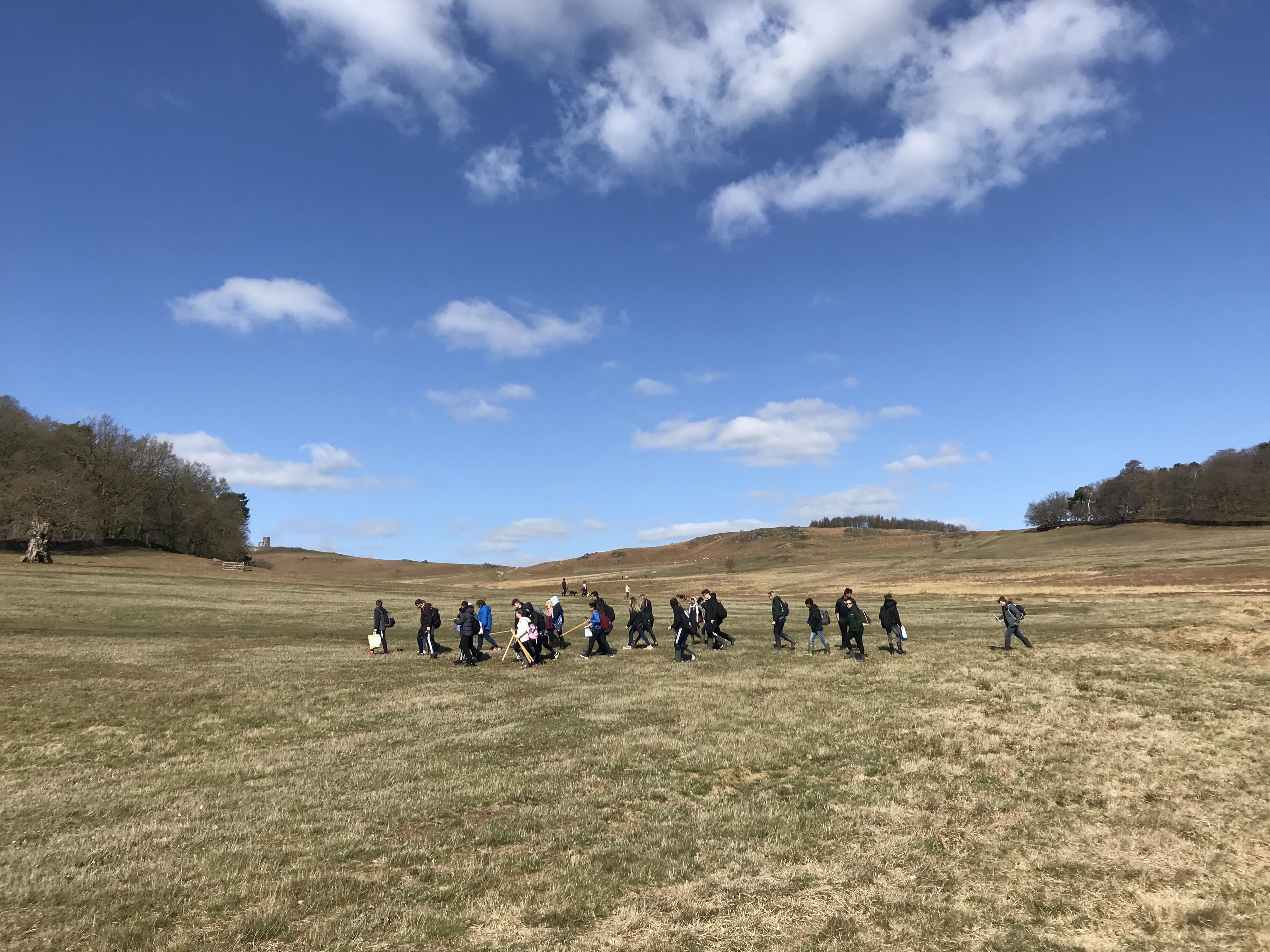
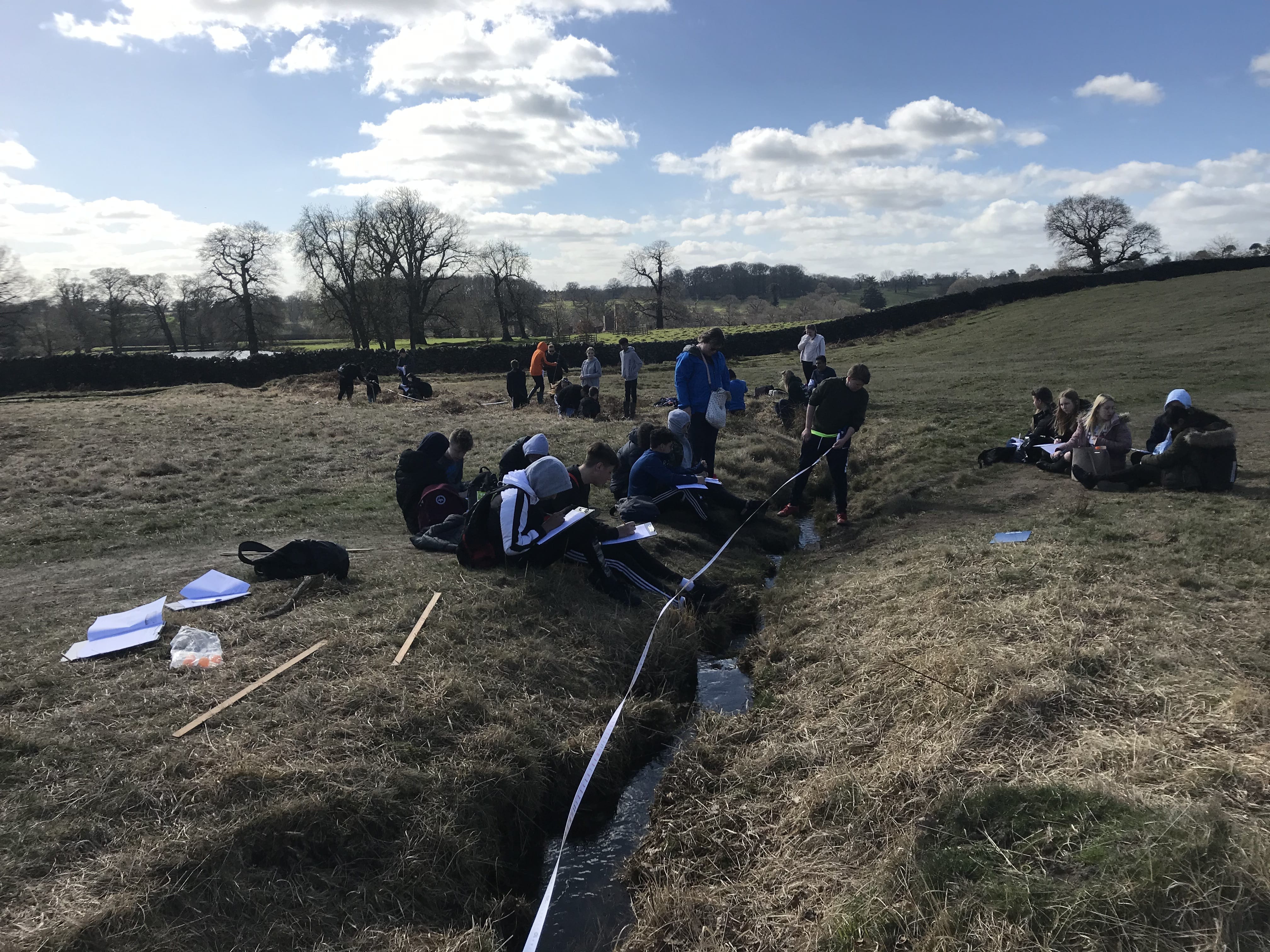
Topic 5- Fieldwork This topic aims to equip students with the skills needed to conduct their own geography fieldwork. Encouraging students to experience geography outside of the classroom allows them to gain a deeper understanding of their environment and the processes that occur. Students will again, look at the idea of sustaining our environment for future generations. They begin by creating their own research question and then explore the school site to collect data from traffic counts, field sketches, bipolar analyses, and questionnaires to support their hypotheses. Students will then analyse the data they have collected, draw conclusions and answer their research question.
Topic 1- Are we building a concrete jungle? This topic is an enquiry into the growth of world cities. With a forever increasing population and the majority of that population living in cities, student will investigate to what degree our megacities are sustainable. Through case studies of Mumbai and London, students will not only look at the opportunities urbanisation offers, but also the increasing challenges that have, and continue to arise. Students will also investigate the different strategies these cities are trying to adopt to become more sustainable to meet the needs of the future generations.
Topic 2- Is Southeast Asia sustainable? Southeast Asia is a unique part of our planet that is not only home to some of the most diverse ecosystems, but also most of the world’s population. Students will explore the delicate balance needed between ecosystems such as the tropical rainforests and the coral reefs, to evaluate the impact of human use of these fragile environments. Students will assess whether the current impact of human activity in Southeast Asia is sustainable and predict what the future of Southeast Asia will look like.
Topic 3- What is Globalisation?


Through this topic, students will explore how culture has changed over time and the main causes of this. In particular, they will look at how technology has been responsible in propelling this change and the impacts, both positive and negative, this change has had on both the human and physical environments. Globalisation is an interconnecting process that has enabled the development of countries all over the world. We will examine how this has happened and the role of trade and aid in creating an interdependent global community.
Topic 4- What makes Russia unique? This topic will focus on Russia and look in detail at the human and physical geography that makes Russia unique. Students will study the climates and diverse landscapes that comprise of this vast country and how this influences the settlement of its population. They will review Russian history and the impact that events have had in shaping and developing Russia. We will establish how much Russia influences other neighbouring countries in Europe through conflict and the provision of fossil fuels.

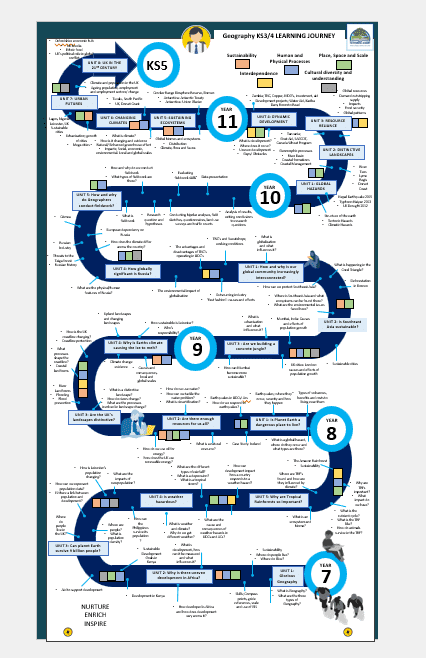
Learning Journey

For more information about Geography in the Curriculum please speak to the Head of Department.